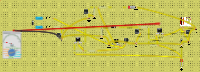
RC & RL Circuit Transient Response
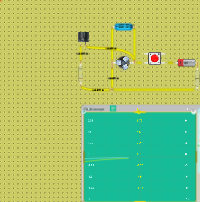
RC Circuit - Switch ON (Charging State) Explanation: At the instant the switch is turned ON (t=0), the capacitor is completely uncharged, acting like a…

Teaching with circuits?
Create a classroom, give your students a circuit to build, and review what they submit. Try it free with one classroom and up to 5 students.
Try the free classroom demoHow it works
RC Circuit - Switch ON (Charging State)
Explanation: At the instant the switch is turned ON (t=0), the capacitor is completely uncharged, acting like a short circuit. Therefore, the capacitor voltage (vC) starts at zero, while the circuit current (i) jumps to its maximum value. As time progresses, the capacitor accumulates charge, causing its voltage to exponentially increase toward the source voltage (Vs), while the circuit current exponentially decays to zero (acting as an open circuit in steady state).
Time Constant Milestone (1τ): At exactly one time constant (τ = RC), the capacitor voltage reaches 63.2% of its maximum value, and the current drops to 36.8% of its initial maximum value.
RC Circuit - Switch OFF (Discharging State)
Explanation: When the switch is turned OFF (or the source is disconnected), the fully charged capacitor acts as a temporary voltage source. It begins releasing its stored energy through the resistor, causing the current to flow in the opposite direction. Consequently, the capacitor voltage exponentially decays from its maximum value down to zero, and the circuit current also decays back to zero from the negative side.
Time Constant Milestone (1τ): At exactly one time constant, both the discharging voltage and the reverse current decay down to 36.8% of their initial values at the moment of switch-off.
What's inside
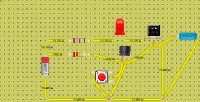
- 1× Battery
- 1× Resistor (1 Ω)
- 1× Capacitor
- 1× Switch
- Measured with Voltmeter/Ammeter